
What You'll Learn in 30 Seconds
This guide is organized around your trousers, not your shoes, so scroll to whatever you have on and take the answer. Navy, grey, khaki, jeans, and brown trousers each get their own line, with a separate quick reference for suits. Whether you searched what color socks with brown shoes or what colour socks with brown shoes, the rule is the same either way. Patterns get a short section too, since they are more welcome than most people assume. Three pairings worth skipping are at the end, along with the reason each one fails.
The One Rule That Makes It Simple
Treat your sock as the last two inches of your trouser leg, not as part of your shoe. When the two colors sit close together, the eye travels from knee to floor without stopping anywhere. The outfit looks planned, even if you put it together in nine seconds.
Matching the sock to the shoe does the opposite. Your trouser ends, a block of brown begins, then the shoe begins again. That puts two hard horizontal breaks right near the floor, and the eye catches on both. The bottom half of the outfit starts reading as separate pieces instead of one leg.
There is a second problem with brown on brown. Brown shoes are rarely one flat color, and sock dye almost never lands on the same shade. A near match looks like a failed attempt at matching. A sock that clearly belongs to your trousers looks like a decision.
Best Sock Colors for Brown Shoes by Trouser Color
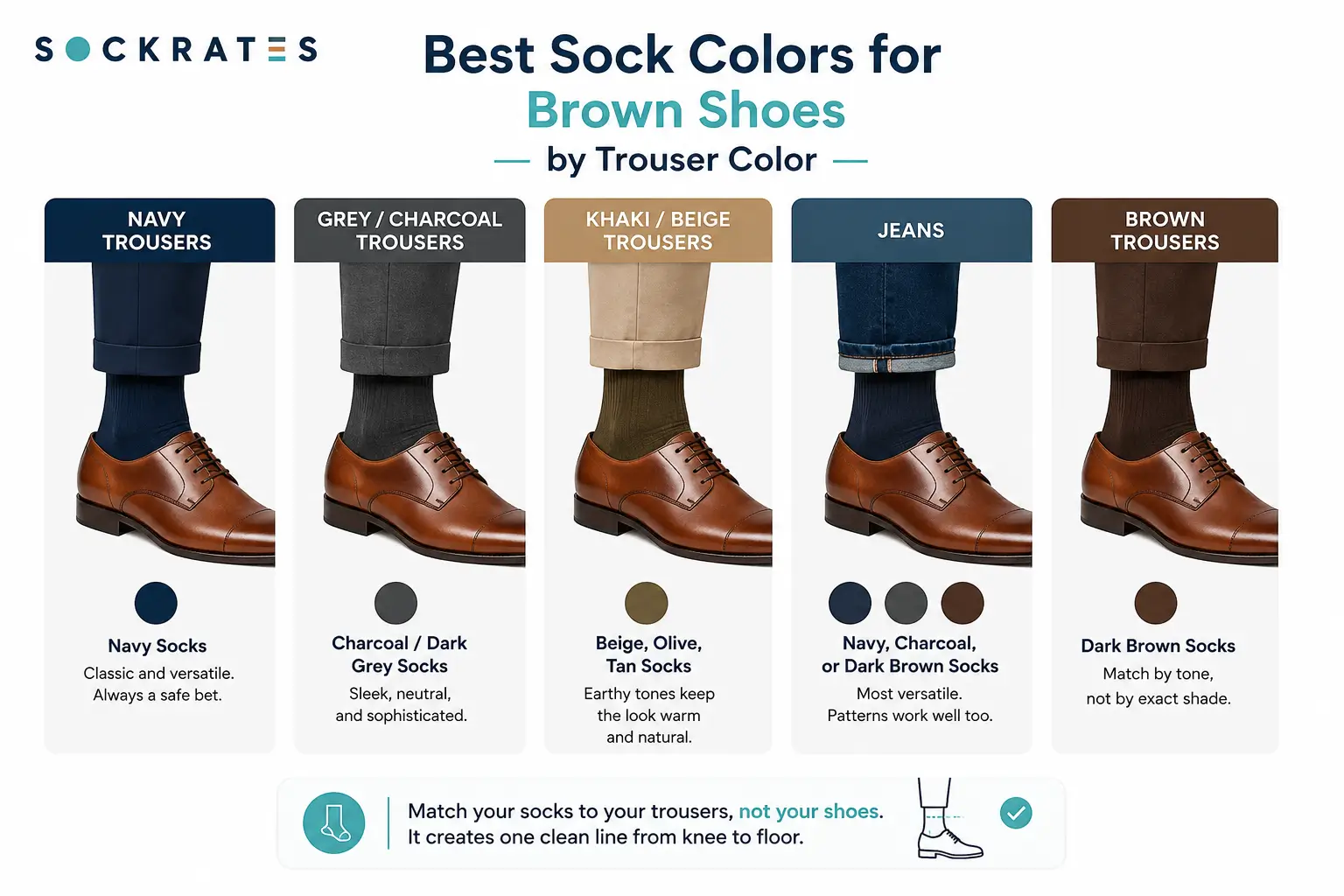
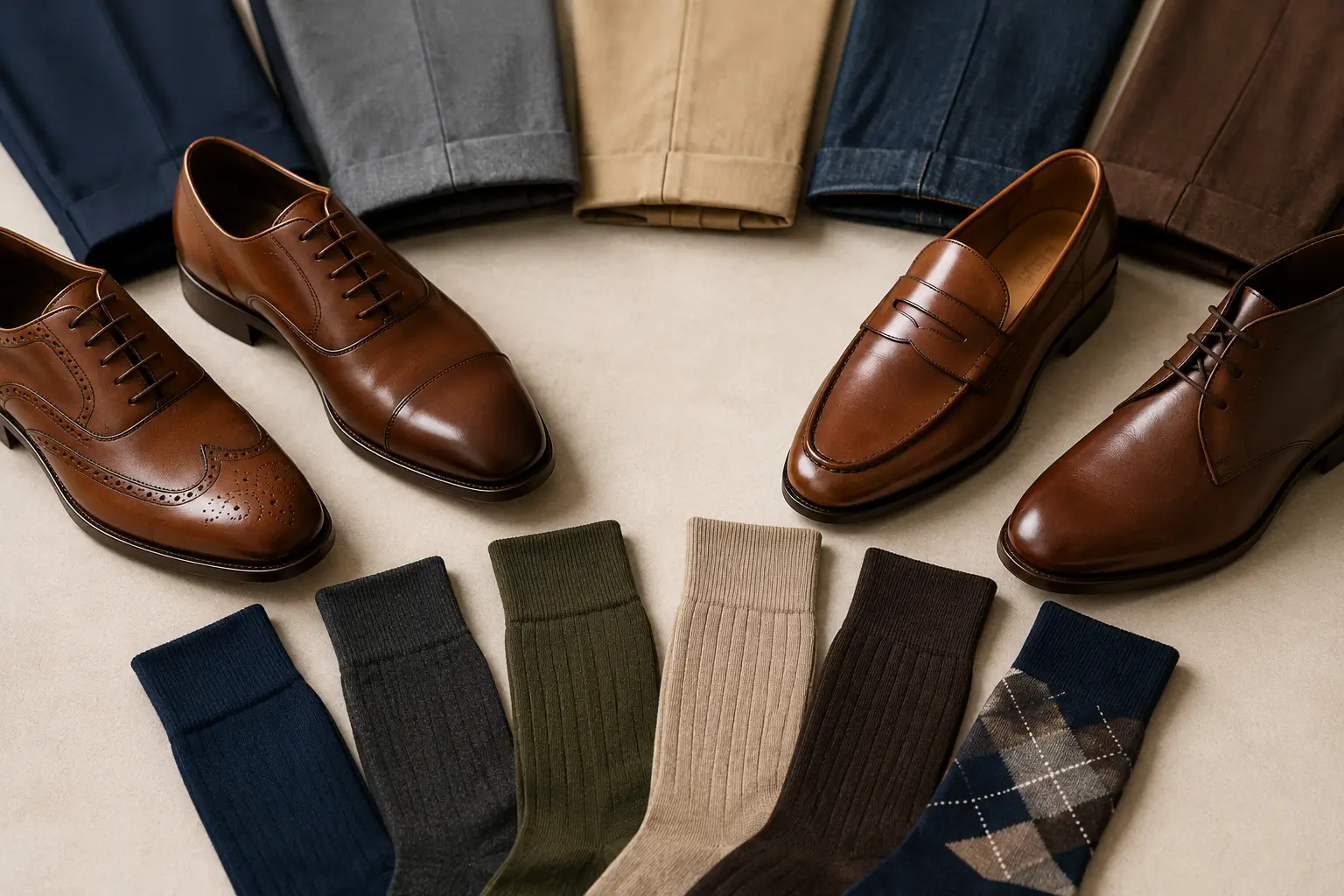
What sits above the shoe decides the sock, far more than the shoe itself does. Here is the shortlist for each trouser you are likely to own.
Navy or Blue Trousers
Navy blue socks with brown shoes is the easiest pairing in menswear. Navy is dark enough for formal outfits and relaxed enough for chinos, so one pair covers a lot of ground. Brown leather warms the whole combination up, which is why it holds together in almost any light.
A slightly lighter blue works too, as long as it stays in the same family. Mid blue socks under navy trousers read as a small, intentional shift rather than a mismatch. Sky blue or bright royal is a different story, because that jump in brightness cuts the leg line in half.
This is also the most versatile option on the list. Interviews, weddings, offices with no written dress code, navy handles all of it.
Grey or Charcoal Trousers
Charcoal or dark grey socks are the default here, spelled grey or gray depending on where you live. They sit close to the trouser in weight and let the brown shoe be the warm note at the bottom. Reach for these when you want zero risk.
Mid grey socks work well for business casual, especially with lighter grey trousers. The aim is to stay within a shade or two of the trouser, not to hit it exactly.
A grey suit with brown shoes is a specific case worth calling out, since so many people ask about it. Charcoal or dark grey socks are the answer, matched to the suit rather than the shoe. Light grey socks under a light grey suit can look sharp as well, though the tones need to be close.
Khaki or Beige Trousers
Beige, olive, tan, and light brown socks all belong with khakis and chinos. Earth tones sit beside the trouser color instead of fighting it, so the leg stays one continuous warm line into the shoe.
Dark socks create too much contrast here. Navy or charcoal against pale khaki draws a hard line at the ankle, and that line is the first thing people see when you sit down. Olive is the quiet favorite of the group, because it flatters nearly every shade of brown leather.
Jeans
Jeans give you the most freedom of anything in your wardrobe. Charcoal, navy, and dark brown all work, and so does a patterned sock built on any of those bases. Denim asks for nothing formal in return.
This is also the natural home for bolder choices. A stripe, a small repeating motif, or a color you would not risk in a meeting all suit the mood of jeans with brown boots or loafers. If you own socks you like too much to hide, this is when to wear them.
Brown Trousers
Brown trousers with brown shoes need one adjustment: match by tone, not by exact shade. A darker brown sock under medium brown trousers keeps the line intact and still gives the leg some depth.
Landing on the identical shade tends to look flat, like one long block of color from waist to toe. Going two or three steps darker is safer than going lighter. Charcoal is a clean alternative if the brown family starts to feel like too much of a theme.
What About Patterns and Textured Socks?
Patterns are fine, and they are not some recent experiment. Argyle, fine stripes, small dots, and ribbed textures all sit comfortably in casual and business casual outfits. Save the loudest of them for days without a dress code.
The real trick is where the pattern gets its colors. Pull one color from your trousers and one from something else you are wearing, a shirt, a tie, a jacket. The sock then looks like part of the outfit instead of something left over from a different one.
Interesting socks stopped being unusual a while ago. Grand View Research valued the global socks market at 49.5 billion dollars in 2025, with lifestyle socks accounting for roughly 60 percent of that. Most socks sold today are bought for how they look, not for sport.
What to Avoid With Brown Shoes
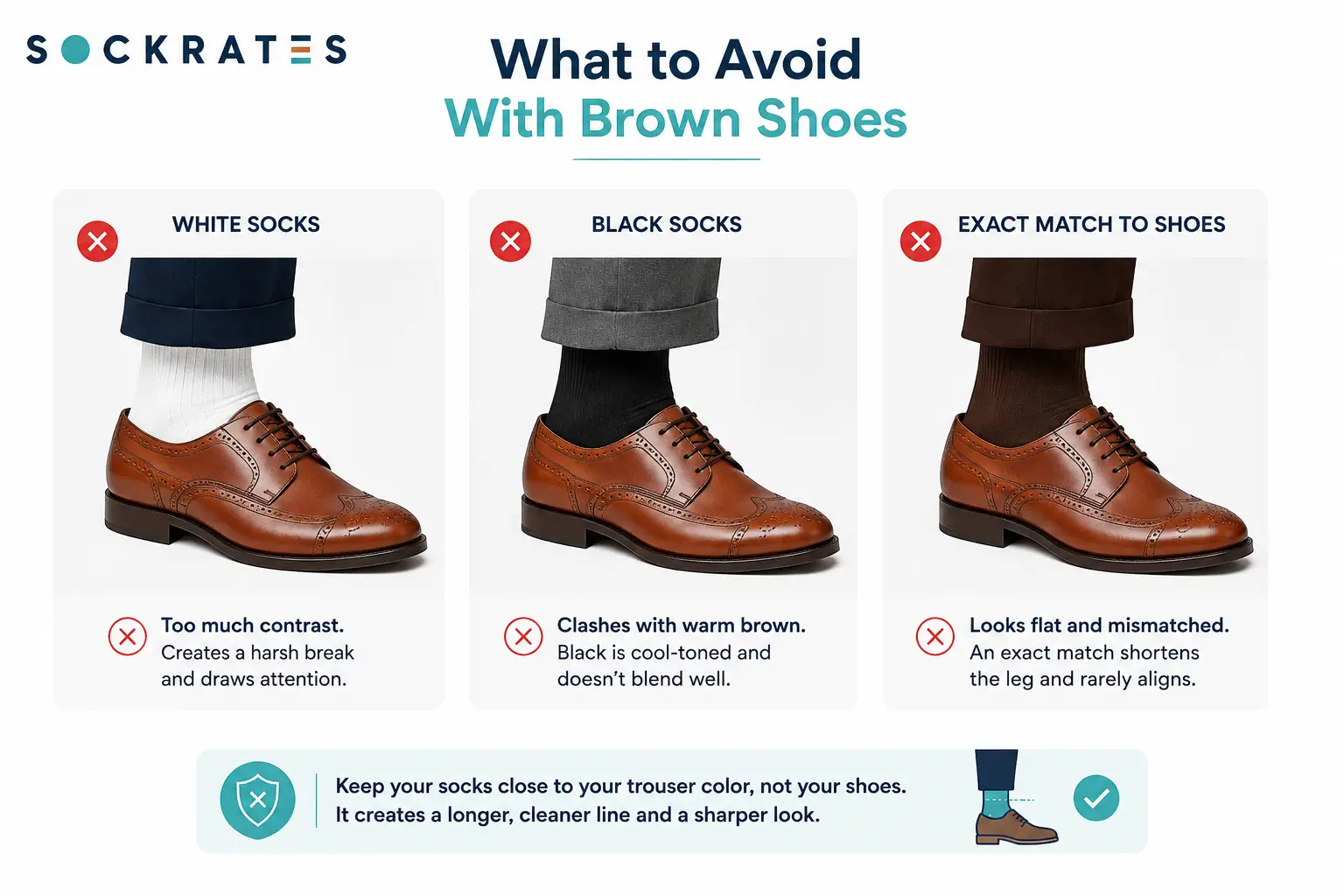
Small clothing details get noticed faster than most people expect. In a study run at the University of Hertfordshire, 274 people looked at faceless photos of a man in two similar suits for no more than five seconds each, and minor differences changed how confident and successful he seemed. These three are the ones people register at the ankle.
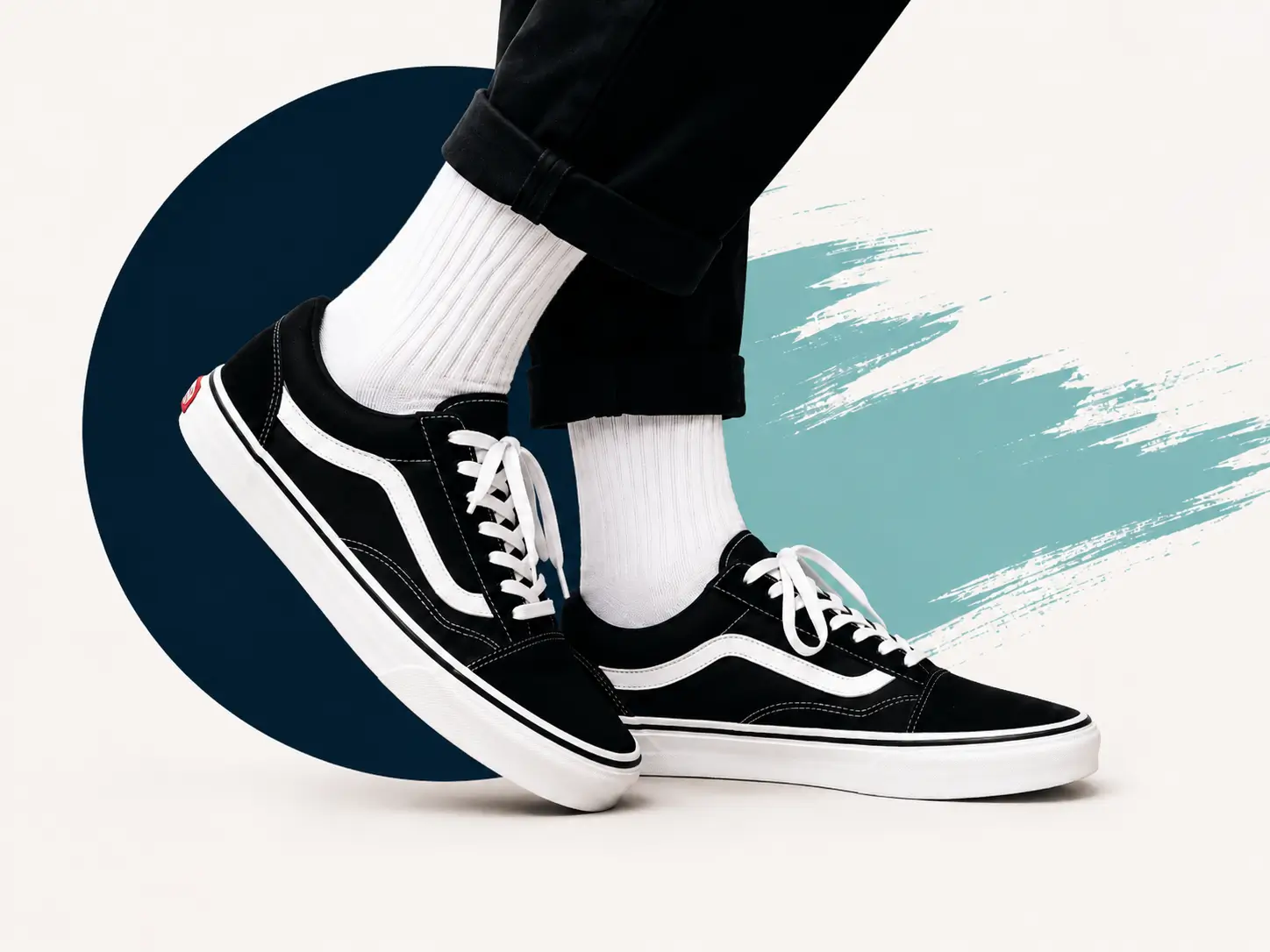
White socks: White cuts a bright band between dark trousers and brown leather, and the eye goes straight to it every time. It is the same problem as black dress shoes with white socks, just warmer and slightly harder to excuse. White has a place with athletic shoes, and arguably with white or cream trousers in summer, but not near brown leather.
Black socks: Black is a cool color and brown is a warm one, so the two rarely settle next to each other. Skip the pairing for anything formal or business related, including a brown shoe with a suit. In very casual outfits, dark jeans with rugged boots, black socks pass without comment, though charcoal does the same job and looks better doing it.
An exact match to your shoe: A sock in the same shade as your shoe makes the leather look taller and the leg look shorter. It also reads as a near miss, since two browns from two different dye lots almost never agree. Move the sock toward your trousers and the problem disappears.
Brown Shoes With a Suit: Quick Reference
Length matters as much as color once a suit is involved, and crew or mid calf keeps skin covered when you cross your legs. That preference shows up in sales too, with mid calf socks holding the largest share of the market in 2025 according to the same Grand View Research report.
Navy suit. Navy socks, nothing else needed. This is the strongest suit and shoe combination you can own, and both dark brown and tan leather work with it.
Grey suit. Charcoal or dark grey socks, matched to the suit. What socks to wear with a grey suit and brown shoes has one honest answer, and it is the color of the suit.
Charcoal suit. Charcoal socks, or black if the suit is very dark and the shoes are deep brown. The sock should never be lighter than the trouser here.
Brown suit. Match the tone and go a step or two darker than the suit itself. Charcoal is a good second option, since it keeps the outfit from turning into one long brown column.
Want to Make a Statement?
Everything above treats the sock as something that blends in. Sometimes you want the opposite, and brown shoes are a forgiving backdrop for it, because warm leather carries color better than black does. If you are outfitting a team, a wedding party, or a company, custom dress socks let you choose the pattern and the exact colors instead of hunting for them in a shop. Our in house designers send free design boards with unlimited revisions, and every pair is Pantone matched and knitted in Italy.
Frequently Asked Questions
Create socks your team will actually be proud to give away