

What you'll learn in 30 seconds
Most club captains hit the same four problems on their first sock order: wrong height, wrong fabric, wrong sizes, and wrong timing. This guide walks through each one with UCI rules explained, fabric trade-offs, a sizing workflow that actually works, real bulk pricing, and a checklist you can save for next season.
Why Cycling Socks Are Different from Regular Custom Socks
Cycling socks are not just athletic socks with a logo. They are specialized kit, and treating them like generic promo socks is the first mistake most clubs make. Four things set a real cycling sock apart from the swag-bag kind:
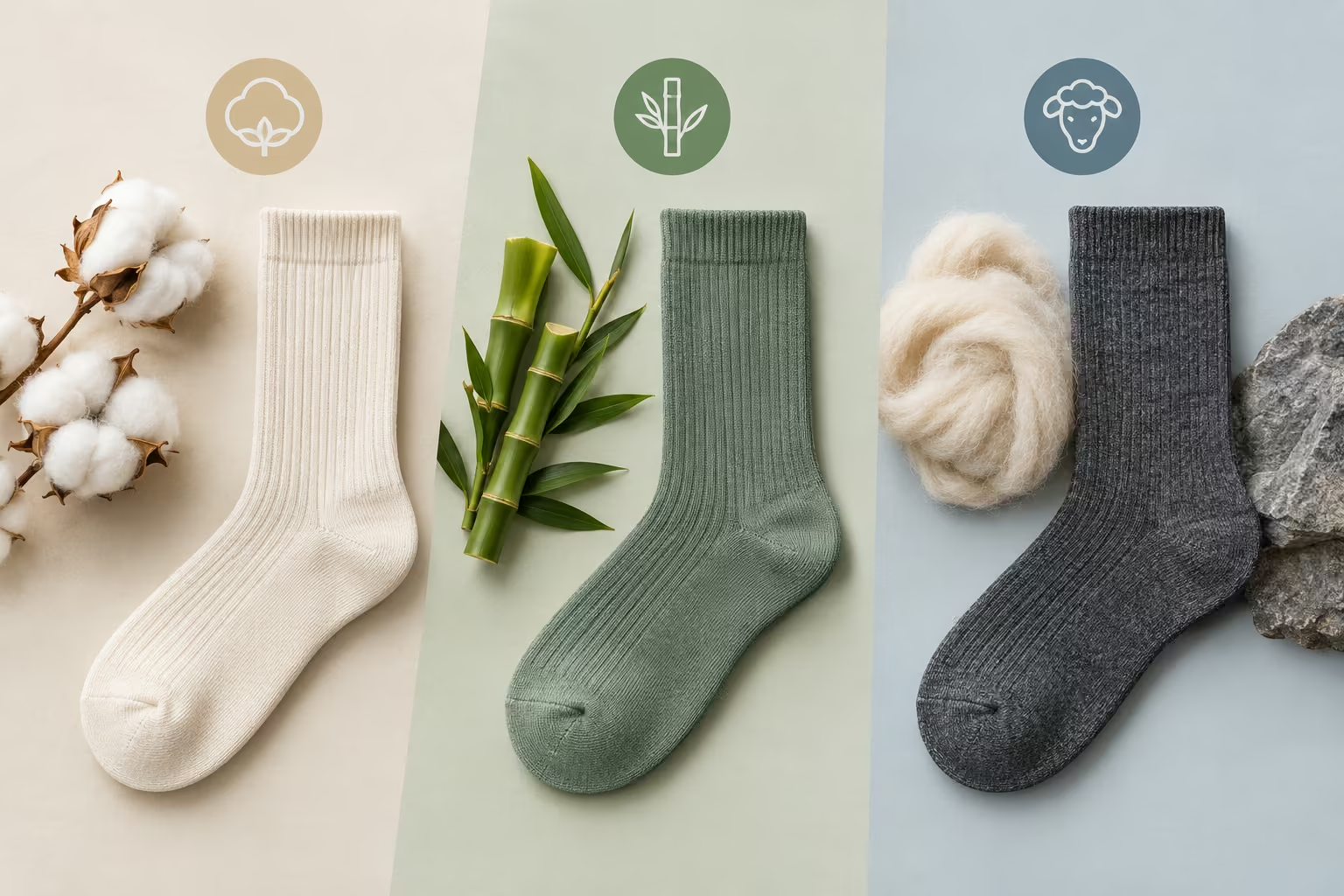
- Fabric built for sweat, not coffee runs: Synthetic blends like polyamide and nylon wick moisture and dry fast. Cotton holds sweat and causes blisters once you pass an hour in the saddle.
- A regulated cuff height: The UCI sets a legal sock height for sanctioned races. Tradition sets the unwritten one for everyone else.
- A snug, locked-in fit: Cycling shoes are stiff and unforgiving. A loose sock bunches under the arch and turns a long ride into a blister clinic.
- Reinforced zones where they matter Extra padding at the toe and heel handles cleat pressure. The upper foot stays thin so shoe fit is not affected.
Cycling Sock Height: UCI Rules and Club Culture Explained
This is the section most articles get wrong, so we will spend time here.
The UCI Rule for Sanctioned Races
The rule is in UCI Regulation 1.3.033. Socks and overshoes used in competition may not rise above the height defined by half the distance between the middle of the lateral malleolus and the middle of the fibula head. In plain language, the sock cannot pass the halfway point between your ankle bone and your knee bone.
This is not just a rule on paper. UCI commissaires use a special measuring device at race starts, and the fines have real teeth. After Annemiek van Vleuten won the 2022 UCI Road World Championships elite women's road race, the race jury still hit her with a 200 CHF fine for socks that climbed too high up her leg. She kept the rainbow jersey. She did not keep the money. Remco Evenepoel was ordered to pull his socks down at the 2019 Yorkshire World Championships start gate before he even rolled off.
The 7.5cm Rule (The Unwritten Club Rule)
This one comes from cycling history, not the rulebook. The classic 7.5cm white sock was worn by Fausto Coppi, Jacques Anquetil, and Eddy Merckx, and Cycling Weekly still credits Coppi as the original style icon who set the standard. The cuff sat above the ankle but below the centre of the shin. Most road clubs still follow this look today. Go shorter and you read as a mountain biker. Go taller and you read as a triathlete or a newcomer.
Choosing the Right Cycling Sock Height for Your Discipline
There is no single right cycling sock height. The answer depends on where you ride, what you ride, and which rules you race under. Here is a quick reference for kit organizers building a kit list across multiple disciplines:
Crew length is not just a preference. Mid-calf socks held the largest segment share of the global socks market in 2025, at 45.59% of revenue. For cyclists, the height adds ankle support and a clean visual line above the shoe cuff.
Choosing the Right Fabric for Your Riders
Why Cotton Is a No
Cotton holds sweat, causes blisters, and breaks down faster after repeated washes. No serious cycling sock uses pure cotton. Mention it once at the kit meeting and move on.
Polyamide and Nylon Blends (The Industry Standard)
This is what most cycling socks use today. A typical blend runs around 96% polyamide and 4% spandex. It wicks moisture, dries fast, and fits inside a cycling shoe without bulk. The same construction sits behind most Italian-made cycling socks, usually paired with subtle mesh paneling on the upper foot and reinforced toe and heel zones for cleat pressure.
Merino Wool Blends (For Cold-Weather Riders)
Merino is the right call for winter riding and shoulder-season gravel. It is naturally moisture-wicking, antimicrobial, and warmer than synthetics. The trade-offs are higher cost and longer drying time. Worth it for clubs in cold climates, or for an off-season kit refresh.
Mesh Paneling and Reinforcement Zones
Look for mesh on the upper foot for airflow. Look for reinforced toe and heel zones for cleat pressure. Look for a seamless toe to stop chafing. These details separate a real cycling sock from a branded gym sock.
How to Get Cycling Sock Sizing Right for a Whole Club
This is the part most articles skip. It is also the part that decides your kit refresh. Get it wrong and you end up with 30 unused pairs in a closet.
One-Size-Fits-Most vs. True Size Runs
Most premium custom cycling sock makers offer one size, usually US men's 6 to 12. This works for the average club. It fails the moment you have outliers, mixed-gender teams, or junior riders on the roster.
When to Order Multiple Sizes
Run true sizing if your roster goes outside US men's 5 to 13. The same applies to women's teams and youth development squads. Multiple sizes usually mean a higher minimum per size, often 50 to 100 pairs each.
How to Collect Sizes Without Losing Your Mind
A few rules that work:
- Send a Google Form with shoe size plus foot length in cm.
- Use the manufacturer's size chart, not generic shoe sizes. Sock fit is not shoe fit.
- Order 5 to 10% extra in your most common size for new members and replacements.
- Set a hard deadline. The last laggard is not worth holding up the order.
You can copy this ready-made Google Form template for your next club kit order: Download Google Form Copy, Just duplicate it to your own Google Drive, swap in your club name and deadline, and send it out
Design Considerations for Cycling Kits
Match the Kit, Don't Clash with It
The visible canvas on a cycling sock is small. It is the gap between your bib short hem and the top of your shoe. That is about four inches of leg. Either match your bib and jersey colors exactly through Pantone, or contrast them cleanly. The worst outcome is a sock color that is almost right but slightly off. It draws the eye for the wrong reason.
Logo Placement on Cycling Socks
The most visible spot on a cycling sock is the outside ankle, also called the lateral cuff. Pro teams and clubs put their primary logo there. Sponsor logos can run vertically up the cuff. Never put the main logo on the foot, since it disappears inside the shoe.
Pantone Color Matching for Kit Consistency
Your club already has Pantone codes from your bib and jersey supplier. Socks must hit the same codes, not a close approximation. Confirm Pantone matching is part of your sock supplier's quote. Some charge extra per color. Sockrates includes full Pantone matching in our all-inclusive pricing, with no per-color fees.
Multi-Sponsor Designs
Race teams have sponsor obligations. Plan logo hierarchy before you start designing, not after. Primary sponsor goes on the lateral cuff. Secondary sponsors stack vertically or sit lower. Always get sign-off from each sponsor on the mockup before production starts.
Knit-In vs. Sublimated: Which Is Right for a Cycling Club?
Knit-In (Woven)
The design is knitted directly into the yarn. It cannot fade, peel, or wash out. The feel is premium and the durability is high. The limit is around 6 to 8 colors, with no smooth gradients. Best for season kits where you want the socks to last multiple seasons.
Sublimation (Printed)
A full-color print is heat-pressed onto polyester. You get photo-realistic art and gradients. The downsides are a less premium feel against skin and prints that can fade after repeated washes.
The Recommendation for Most Clubs
Knit-in for season kits and core team gear. Choose sublimation only if your design genuinely needs gradients or photo-detail. For most clubs running one or two kit refreshes a year, knit-in is the safer choice. If you want to dig deeper into the trade-offs, this woven vs sublimated guide breaks down both methods side by side.
How Much Do Custom Cycling Socks Cost for a Club?
Custom cycling socks sit in a clear price band by volume. Here are typical industry ranges for premium knit-in socks:
A fair quote should include free design, unlimited revisions, Pantone matching, header labels, and worldwide shipping. If a supplier quotes lower and adds those fees later, you end up at the same total. Sometimes higher. Sockrates uses an all-inclusive pricing model. Design, revisions, labels, and shipping are all bundled into the per-pair price.
Budget tip for first orders. They include design setup work, so the per-pair cost is slightly higher than a reorder. A reorder of the same design is always cheaper.
How Long Does a Custom Cycling Sock Order Take? MOQs and Lead Times Explained
Typical MOQs
- Knit-in cycling socks: around 100 pairs from premium suppliers.
- Sublimated cycling socks: 12 to 30 pairs depending on the printer.
- Per-size minimum: usually 50 to 100 pairs per size if you run multiple sizes.
Realistic Lead Times
- 7 days production: best-in-class, Italian factories with cycling specialty.
- 3 weeks: typical for premium overseas suppliers.
- 6 to 12 weeks: mass-market overseas factories.
Add shipping to all of those numbers. For a gran fondo, charity ride, or race weekend, start the order at least 8 weeks out. That leaves room for design revisions and any production delays.
Custom Cycling Sock Order Checklist for Club Captains
Save this and paste it into your club Slack or Discord:
- Confirm your event date and work backward at least 8 weeks.
- Lock your kit Pantone codes from your bib and jersey supplier.
- Decide sock height based on your discipline.
- Choose knit-in or sublimated based on your design needs.
- Collect rider sizes through a Google Form with a hard deadline.
- Order 5 to 10% extra in your most common size.
- Get all sponsor logos in vector format (AI, EPS, or SVG).
- Get an all-in landed cost quote, including Pantone, labels, and shipping.
- Approve the digital mockup carefully.
- Request a pre-production sample if the order is over 250 pairs.
- Confirm one shipping address. Clubhouse or captain's home, not both.
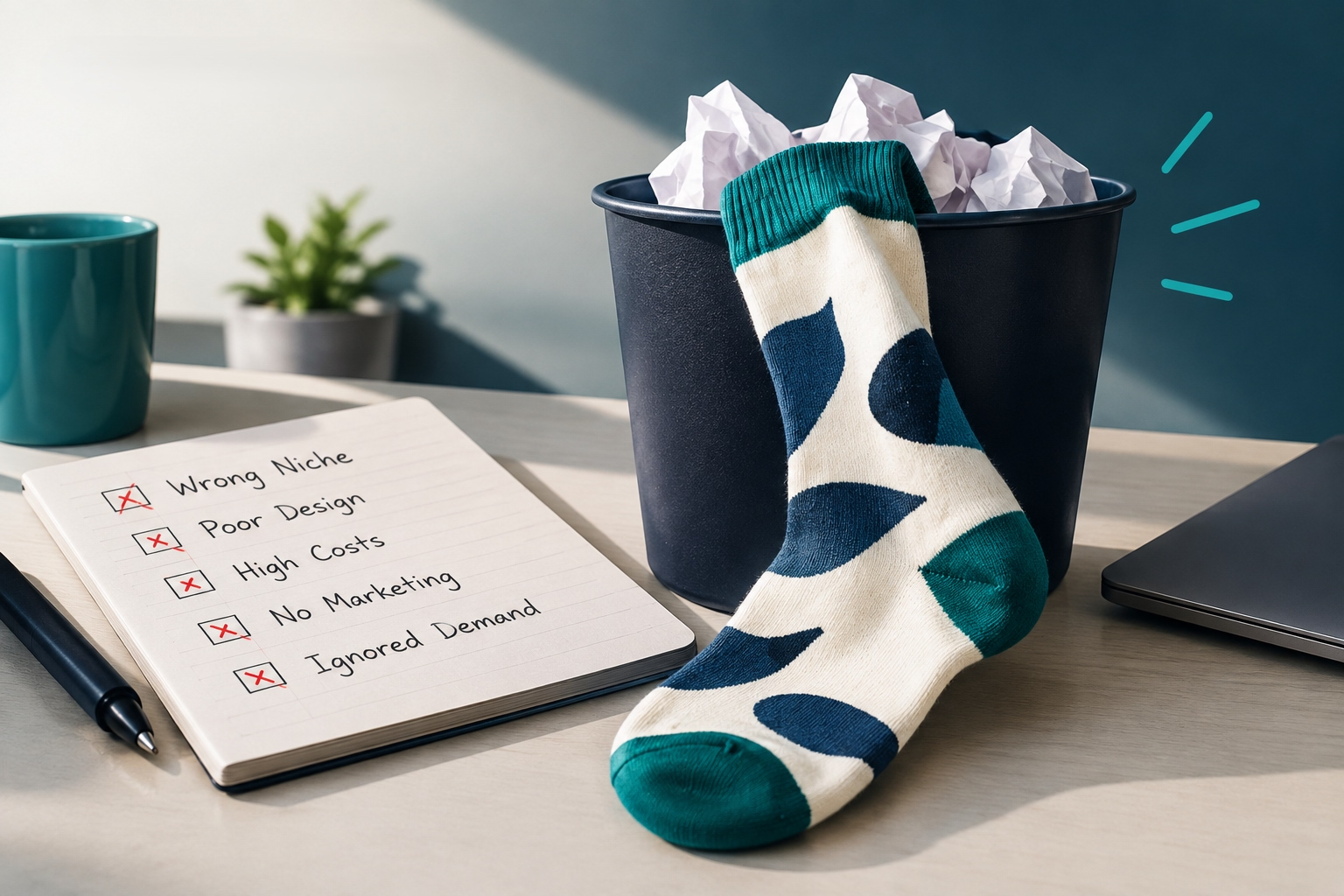
Common Mistakes Cycling Clubs Make on Their First Order
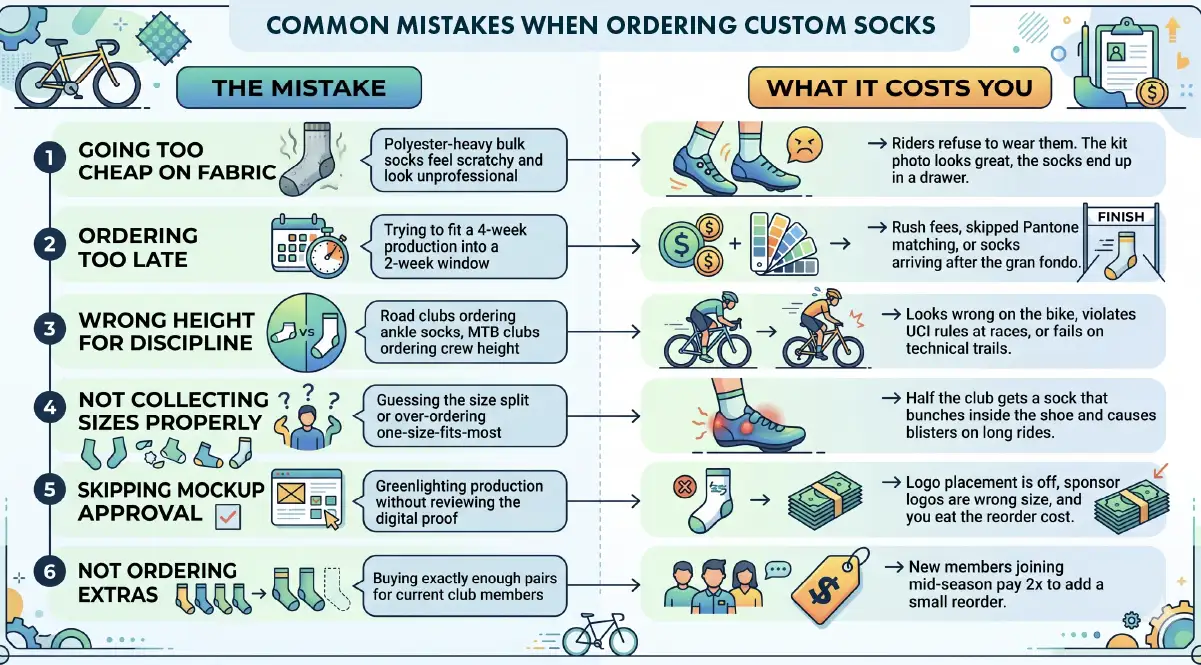
A short, honest list:
- Going too cheap on fabric: Polyester-heavy budget socks feel scratchy and end up in the bin.
- Ordering too late: A two-week scramble means rush fees or no socks at all.
- Wrong sock height for the discipline: MTB clubs in low-cut socks. Road clubs in tube socks. It looks off.
- Skipping size collection: You end up with 30 pairs in XL and 5 pairs in S.
- Skipping mockup approval: Logos placed wrong, sponsors unhappy, no time to fix it.
- No extras for new members: A mid-season refresh costs more than ordering 10% extra upfront.
The Bottom Line for Club Captains
Custom cycling socks are one of the highest-impact, lowest-friction additions to a club kit. They unify the team, make the group photo look professional, and last multiple seasons if you order them right. Most of the mistakes happen upstream. Rushing the timeline. Cheaping out on fabric. Skipping size collection. Going with a supplier that adds fees after the quote.
Get those four right and the rest is easy.
Want an all-inclusive quote with free designs and unlimited revisions? Sockrates offers full Pantone matching and a 7-day production turnaround on premium Italian-made cycling socks. You can get free designs from our team here.
Frequently Asked Questions
Create socks your team will actually be proud to give away